Infection Control
Infection control, prevention, and biosecurity: Making a plan
AAHA guidelines highlight the importance of having an infection control, prevention, and biosecurity (ICPB) plan and how to implement one in your clinic.
Advertisement
Does this scenario sound familiar? A client schedules an appointment for their new puppy and mentions they have noticed a little diarrhea. When the puppy presents in the clinic, it’s immediately clear that he is very sick. The owner reports that over the last two days, the diarrhea has gotten worse and is now bloody. Today, the puppy is not eating and has just started vomiting. The patient provides a sample of the bloody diarrhea on your exam room floor, and there’s that unmistakable smell.
Ten minutes later, a parvo test confirms your team’s suspicions. Your client is on board with your treatment plan for her new puppy, and your technician starts setting up a cage in isolation. But you have other puppies on the schedule for today, as well as a patient with a history of autoimmune disease who can’t be vaccinated and a whole kennel full of boarding dogs. Are you confident that your infection control plan will ensure that no other patients will be exposed?
Advertisement
The 2018 AAHA Infection Control, Prevention, and Biosecurity Guidelines were created in part to help guide veterinary hospitals as they plan for this type of scenario and reduce the risk of infectious disease spread among patients and humans in the hospital setting. To accomplish this, the guidelines state that every veterinary practice should have an infection control, prevention, and biosecurity (ICPB) plan that keeps the veterinary hospital from being a source of contagion.
Creating an ICPB
According to the guidelines, “without effective infection control, prevention, and biosecurity implemented in the veterinary primary care and referral settings, the clinician’s effort at disease prevention and treatment are compromised and, in some cases, nullified.” While an ICPB can start as a set of basic infection control practices and standard operating procedures, it can (and should) grow over time into a comprehensive manual that encompasses team education and training, client education, surveillance, and compliance programs to ensure maximum effectiveness.
The following steps are essential to creating an effective ICPB:
- Appoint an infection control practitioner/preventionist (ICP) to oversee the creation of the ICPB
- Develop protocols and associated checklists for activities and procedures that involve exposure to infectious diseases or that require special effort to prevent infection. These should include tasks like personal hygiene, cleaning and disinfection, donning and doffing personal protective equipment, identifying high-risk patients, placing and maintaining IV and urinary catheters, entering and exiting isolation wards, and necropsy procedures, among others.
- Perform an initial assessment of the facility to identify what is already working well and which areas need additional attention
- Develop training and educational plans for all personnel, including volunteers and temporary staff members. This training should be repeated at least annually.
- Select one team member to collect or create educational materials for clients on zoonotic and infectious diseases.
- Institute a surveillance program to ensure that the ICPB is effective, making note of any needed changes.
- Create a compliance evaluation program to ensure that all members of the team are abiding by the infection containment protocols.
Practical applications of an ICPB
Let’s return to the puppy diagnosed with parvovirus and apply some of the general principles described in the guidelines to show how having an ICPB would help everyone on the team know how to limit the spread of the virus throughout the hospital.
Flow of staff and patients
A good ICPB recognizes that the patient and the staff who have contact with them can be sources of transmission of infectious disease in the hospital and makes efforts to limit this spread by controlling their movement to minimize spread. Identifying patients who are at high risk for transmitting an infectious disease can start even before the patient presents in the hospital. When clients call to schedule an appointment, client service representatives can ask specific questions when indicated to gauge the level of risk.
For a puppy with diarrhea, these questions can include asking about the puppy’s age, vaccination status (if not known), possible exposure history (dog park, shelter, recent adoption, etc.), the presence of blood in the stool, any known vomiting, and the puppy’s attitude and energy level. If any of these answers raise concern for a likelihood of parvovirus, the client may be instructed to stay in their car with their puppy instead of coming into the waiting room until staff is ready to assess the patient.
Personnel may decide to assess and test the puppy outside of the hospital or in an isolated exam room or isolation ward to avoid introducing infectious material into the common areas of the hospital. If the client is to bring the puppy inside, staff may instruct the owner to carry the puppy instead of letting them walk on their own. Any time the patient is brought into the hospital, the team should have a pre-planned route for them to enter that will minimize the potential contamination of other areas of the hospital.
Likewise, staff who interact with the patient and the owner should minimize their movement around other areas of the hospital to the extent possible. This might mean that the technician working with the puppy will avoid walking through the kennel area and not walk into exam rooms where puppies and other dogs will be seen throughout the day.
Hand Hygiene
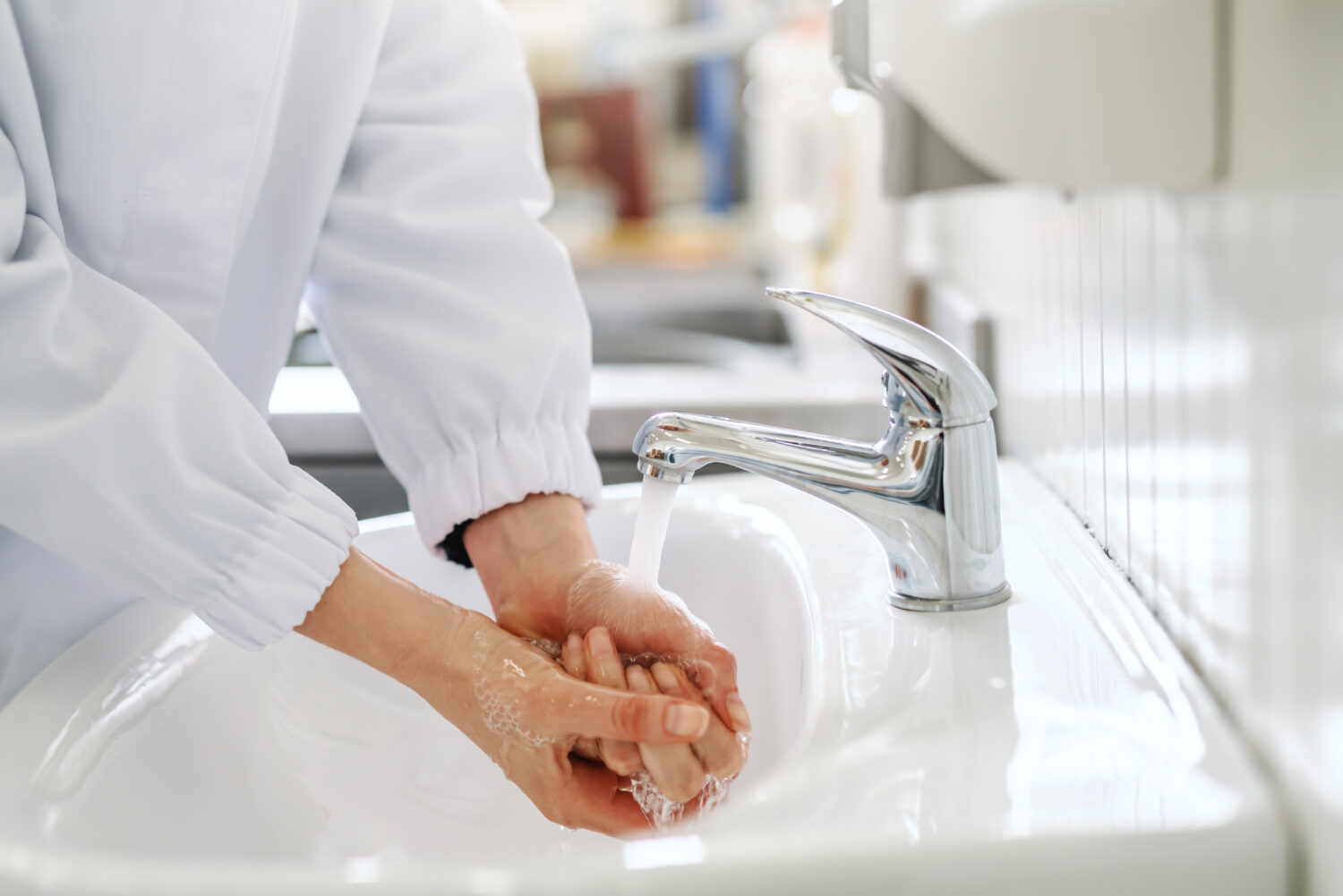
Even with appropriate personal protective equipment, it is very important that all individuals who handle the patient, their bodily fluids, and any surfaces they touch wash their hands thoroughly or use an alcohol-based hand sanitizer (AHS) after each interaction. According to the guidelines, this step is the “single most important way to prevent infections in healthcare,” and it is also critical to perform before and after every patient contact even when no infection is suspected.
The guidelines also identify AHS as the “preferred method when hands are not visibly soiled” because of superior antimicrobial activity when compared to hand soaps, but not in the case of infectious organisms like Crytosporidium spp. and parvovirus, against both of which AHS are not effective. When these organisms are present or when the hands are visibly soiled, the use liquid or foam hand soap to wash hands is preferrable. Bar soap should never be used.
Cleaning and Disinfection
Cleaning and disinfection are very important in the prevention of the spread of infectious diseases, but they are not the same thing. Cleaning refers to the “removal of visible organic matter” using soap or detergent, whereas disinfection involves using a product to kill any infectious material remaining on a surface after it has been properly cleaned. In the guidelines, a table of selected disinfectants from The Center for Food Security and Public Health at Iowa State University describes the properties of various disinfectants and which types of microorganisms they are effective against. For our parvovirus example, this table indicates that alcohols and quaternary ammonium compounds are likely not the best choices for killing a nonenveloped virus such as parvovirus.
In addition to appropriate product selection for a given infectious organism, it is important to select an appropriate dilution and contact time for each disinfectant. Other important factors include the porosity of the surface being disinfected, how frequently a surface is being used, and whether a second round of disinfection is indicated to kill any remaining organisms after the first round. Personnel should use appropriate PPE and ensure adequate ventilation of areas when using disinfectants.
PPE
In the prevention and containment of infectious disease, PPE serves multiple purposes: it protects the personnel wearing it from exposure to pathogens and it also reduces the risk of turning the individual and their clothing and equipment into sources of transmission. As important as it is, PPE is considered the “last line of defense” after the previously mentioned measures have been maximized to reduce contamination and transmission.
The guidelines explain that the type of PPE utilized will vary from one case to another, but that some form of PPE should be used with every patient encounter. The manner in which PPE is removed and how often it is laundered and disposed of is as important as the type of PPE used.
Returning to the parvovirus example, several specific recommendations from the guidelines apply: at least daily laundering of lab coats and scrubs; not wearing any PPE outside of the isolation area or wherever the patient is being examined or treated; gloves, gowns, and shoe covers are disposed of and not reused (even when going back to the same patient); gloved hands do not touch any surfaces that will later be touched by non-gloved hands. Shoe covers are recommended over foot baths and foot mats due to concerns over effectiveness with the latter two options.
Infectious disease containment is just one element that is covered in the guidelines. Other areas of focus include disinfection of rehabilitation and surgical equipment, handling pets fed raw meat diets, minimizing the aerosolization of pathogens, and the safe performance of necropsies. This includes both recommendations for individual behavior, environmental modulation, and client-facing educational efforts.
Although it can feel overwhelming to start implementing for practices who don’t currently have any kind of plan in place, the guidelines were written to help those without a plan feel “heartened and encouraged to take small steps” that incrementally can lead to a more comprehensive plan. Check out the guidelines today to get started!
Photo credit: dusanpetkovic/iStock via Getty Images
Disclaimer: The views expressed, and topics discussed, in any NEWStat column or article are intended to inform, educate, or entertain, and do not represent an official position by the American Animal Hospital Association (AAHA) or its Board of Directors.