Section 5: Real-World Collaboration
Finding common ground to effect real change.

Top 3 Takeaways
- Collaboration requires the desire and willingness to participate actively in what is best for the patient and their caregiver(s).
- Committing to building both interprofessional and interorganizational collaboration benefits the patient, the family unit, the team members, and the practice.
- Key concepts for successful collaboration include building positive relationships through effective communication strategies, dispelling myths and creating trust, and developing a supportive and respectful environment.
Overview
Equitable access to veterinary care is a complex issue that requires an interdisciplinary and collaborative approach, bringing together private veterinary practices, government and nonprofit organizations, and pet caregivers to identify and implement sustainable solutions. Over the past 15 years, human health care has moved from the traditional in-hospital model of care toward community-based health care.1,2 This redesign of the health care system attempts to address the socioeconomic impact of patients with limited financial resources, aging populations, and comorbid chronic diseases.3,4,5,6
Such efforts found that effective interprofessional and interorganizational collaboration serve as critical components of a successful community-based health care system.7 Collaboration in human health care has been shown to improve patient outcomes, such as reducing preventable adverse drug reactions,8,9 decreasing morbidity and mortality rates,10,11 and optimizing medication dosages.12 Collaborative teamwork also provides benefits to health care providers, including reducing extra work13 and increasing job satisfaction.14
Veterinary medicine can apply this same model, envisioned as three circles of collaboration, in the context of a private practice: (1) collaboration among team members in the practice; (2) working with other veterinary practices in the community (e.g., other private practitioners, nonprofit practitioners, and specialists); and (3) collaborating with other allied health providers (e.g., physicians, nurses, mental health professionals, and social workers), suppliers, and other community service providers (Table 5.1).
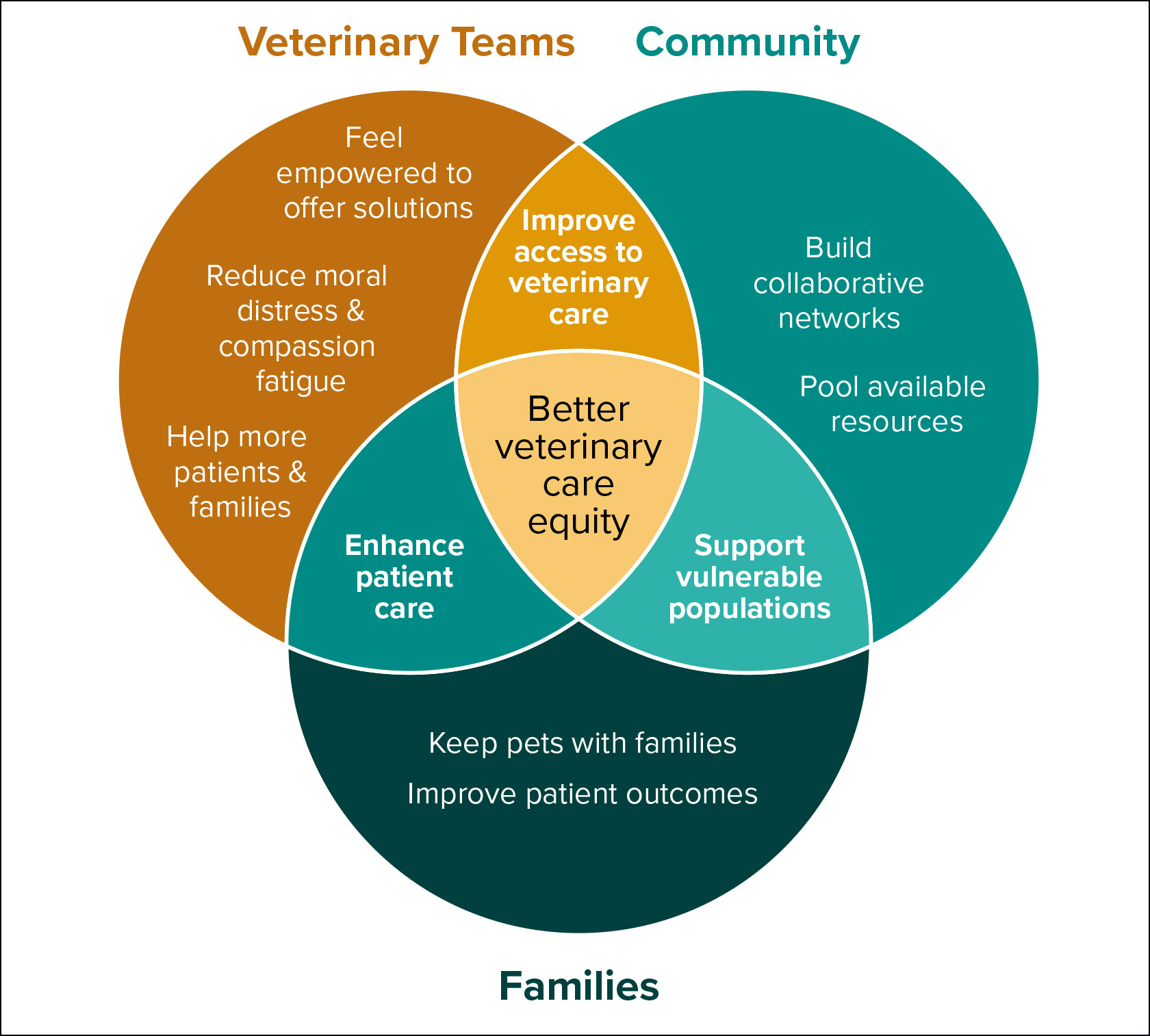
The positive impact of collaboration for organizations is well established (Figure 5.1).15,16 Collaboration can create opportunities to share knowledge and expertise and contribute to the professional development of the entire team, optimize available resources and promote resource-sharing, and support continuity of care. Collaboration can also inspire creative and innovative approaches to problem-solving and promote business growth by expanding services, opening new markets, and increasing capacity to serve clients.17
| Aspect | Interprofessional Collaboration | Interorganizational Collaboration |
|---|---|---|
| Definition | Collaboration between professionals from different disciplines within a single organization. Includes veterinarians, technicians, assistants, customer service representatives, and veterinary social workers | Collaboration between multiple organizations or entities to achieve shared goals or address common challenges; involves representatives from different organizations, each with their own goals and expertise |
| Focus | Coordinated services to provide integrated care for a specific patient/client case or scenario within a single institution | Collective action of broader issues, such as community-based initiatives, policy advocacy, or access to veterinary care involving multiple stakeholders in the community |
| Benefits | Enhanced patient care by integrating expertise from various disciplines | Enables pooling of resources, access to a wider range of services, and collective problem-solving for a more significant impact |
| Challenges |
|
|
| Example in a veterinary setting | Interprofessional teams in a specialty hospital treating a complex medical case | Collaborative efforts among a veterinary clinic, a human social services organization, and a retail store to offer basic veterinary care and free pet food to the community |
Karam M, Brault I, Van Durme T, et al. Comparing interprofessional and interorganizational collaboration in healthcare: a systematic review of the qualitative research. Int J Nurs Stud 2018;79:70–83.
Gaboury I, Bujold M, Boon H, et al. Interprofessional collaboration within Canadian integrative healthcare clinics: key components. Soc Sci Med 2009;69(5):707–15.
The 2024 AAHA Community Care Guidelines for Small Animal Practice are generously supported by CareCredit, Hill’s Pet Nutrition, IDEXX, Merck Animal Health, and Pawlicy Advisor.





Citations
- van Hoof SJ, Kroese ME, Spreeuwenberg MD, et al. Substitution of hospital care with primary care: defining the conditions of primary care plus. Int J Integr Care 2016;16(1):12.
- MacLeod MLP, Hanlon N, Reay T, et al. Partnering for change. J Health Organ Manag 2019;34(3):255–72.
- Barnett K, Mercer SW, Norbury M, et al. Epidemiology of multimorbidity and implications for health care, research, and medical education: a cross-sectional study. Lancet 2012;380(9836):37–43.
- World Health Organization. Global Status Report on Noncommunicable Diseases 2014. Available at: https://iris.who.int/bitstream/handle/10665/ 148114/9789241564854_eng.pdf?ua=1. Accessed May 15, 2024.
- van der Wees PJ, Wammes JJG, Westert GP, et al. The relationship between the scope of essential health benefits and statutory financing: an international comparison across eight European countries. Int J Health Policy Manag 2016;5(1):13–22.
- McPhail SM. Multimorbidity in chronic disease: impact on health care resources and costs. Risk Manag Healthc Policy 2016;5(9):143–56.
- Karam M, Brault I, Van Durme T, et al. Comparing interprofessional and interorganizational collaboration in healthcare: a systematic review of the qualitative research. Int J Nurs Stud 2018;79:70–83.
- Kucukarslan SN, Peters M, Mlynarek M, et al. Pharmacists on rounding teams reduce preventable adverse drug events in hospital general medicine units. Arch Intern Med 2003;163:2014–8.
- Leape LL, Cullen DJ, Clapp MD, et al. Pharmacist participation on physician rounds and adverse drug events in the intensive care unit. JAMA 1999;282:267–70.
- Wheelan SA, Burchill CN, Tilin F. The link between teamwork and patients’ outcomes in intensive care units. Am J Crit Care 2003;12:527–34.
- Hall D, Buchanan J, Helms B, et al. Health care expenditures and therapeutic outcomes of a pharmacist-managed anticoagulation service versus usual medical care. Pharmacotherapy 2011;31:686–9.
- Martinez AS, Saef J, Paszczuk A, et al. Implementation of a pharmacistmanaged heart failure medication titration clinic. Am J Health Syst Pharm 2013;70:1070–6.
- Jones B. The science behind the growing importance of collaboration. Kellog Insight. September 6, 2017. Available at: https://insight.kellogg. northwestern.edu/article/the-science-behind-the-growing-importance-ofcollaboration. Accessed May 15, 2024.
- Chang WY, Ma JC, Chiu HT, et al. Job satisfaction and perceptions of quality of patient care, collaboration and teamwork in acute care hospitals. J Adv Nurs 2009;65:1946–55.
- Jones B. The science behind the growing importance of collaboration. Kellog Insight. September 6, 2017. Available at: https://insight.kellogg. northwestern.edu/article/the-science-behind-the-growing-importance-ofcollaboration. Accessed May 15, 2024.
- Hindi TN, Frenkel A. The contribution of collaboration to the development of sustainable innovation in high-tech companies. J Innov Entrep 2022;11:62.
- Hindi TN, Frenkel A. The contribution of collaboration to the development of sustainable innovation in high-tech companies. J Innov Entrep 2022;11:62.