Section 6: Community Care Networks in Action
Connecting access-to-care solutions.

In This Resource:
- FIGURE 6.1 Integrated community care and an asset-based approach
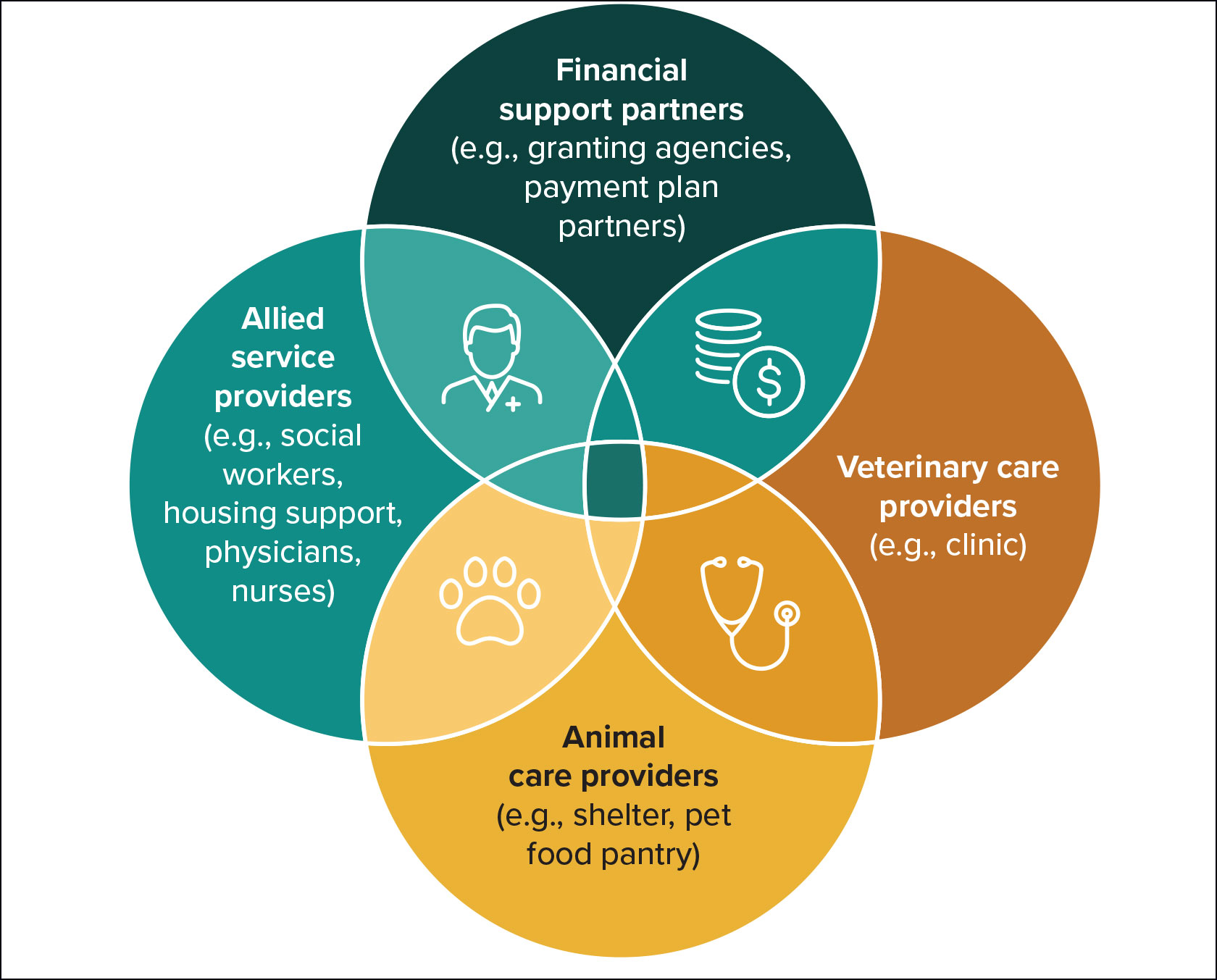
- FIGURE 6.2 Diagram of Organizational assets that contribute to a community care network
- TABLE 6.1 How to refer a case to a nonprofit veterinary or animal shelter practice
- BOX 6.1 Understanding animal shelter terminology and roles
- TABLE 6.2 Financial Assets Available to Clinics for Case Support
Top 3 Takeaways
- A community care network enrolls affiliates of private practices in case management for both people and pets. Pet care affiliates include nonprofit and low-cost clinics, shelters, and rescue groups. Human service providers include behavioral health providers, housing agencies, and other social service networks.
- Keep a list of community resources, including other veterinary care providers, allied services, and animal welfare organizations, to provide a spectrum of care.
- Mirror the same process and relationship when referring a patient to another community provider as for referral to other types of practices. Establish mutually beneficial referral relationships.
Overview
A community care network relies on a system of diverse service providers who collectively eliminate gaps in care for patients and families due to health inequities (Figure 6.1).1 Although perhaps a new concept for veterinary teams, human health care systems commonly discuss and implement such networks.2,3
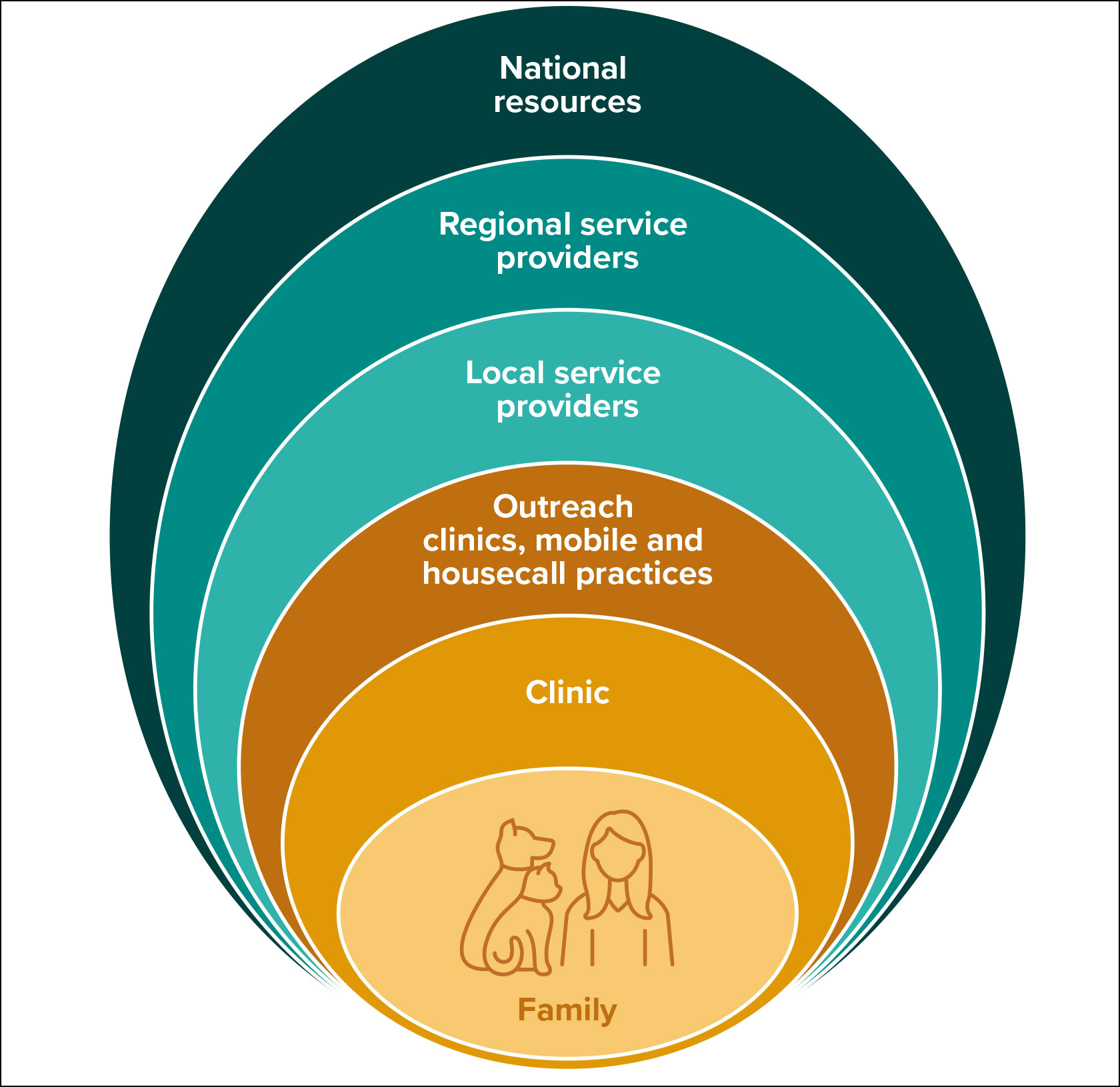
Using existing networks will always be easier than building something new, especially because veterinary practices bring limited time and resources to this effort. Starting with an asset-based framework honors, supports, and prioritizes service providers already working in the field. Mobilizing passionate team members helps build the network. Increased use of technology allows for networks to extend beyond geographical boundaries and tap into resources that lie outside of local and regional borders.
Identify Community-Based Challenges Clients Face
While the veterinary team focuses on medical treatment, the client may also face multifaceted and systemic challenges, requiring additional community support (Section 2, Table 2.1). These issues impact decision making and the scope of care families can provide.4 Many of the same social determinants of health and health inequities that impact people also impact the health status and care of pets.5,6
Work from an Asset-Based Framework
An asset-based framework values the existing capacity, skills, knowledge, and connections in individuals and communities. This approach focuses on the positive capacity of individuals and communities rather than on their needs, deficits, and problems.7,8 This approach to thinking about family and patient needs, as well as community resources, provides a useful reframing of the challenges encountered in providing care and illuminates the strengths exemplified by individual and collective efforts.
Grow Partnerships Across the Community Care Network
The community care network comprises many assets, such as different types of organizations performing different aspects of support to include financial, direct veterinary care, and allied services (Figure 6.2). Organization assets provide the basis for partnerships that ensure all pet caregivers in a community have access to veterinary care. In some cases, a single partner may provide more than one of these elements (e.g., an animal shelter offering food and clinic services).
Emerging Professional Niches
The field of shelter medicine originated as an area of expertise regarding the health and welfare of animal populations in shelters. It has since evolved to recognize that improving animal welfare also means addressing veterinary care for owned and community animals.9 Whereas shelter veterinarians traditionally treated surrendered, lost, and stray animals, as the access-to-care issue has gained prominence,10 they increasingly care for animals who live with low income families. The shelter medicine specialty was recognized by the AVMA in 2014,11 and in 2023 was fully recognized by the American Board of Veterinary Specialties. The broadening scope of practice for shelter veterinarians has greatly contributed to the establishment of the related discipline of community medicine. The Journal of Shelter Medicine and Community Health, founded in 2022 by the Association of Shelter Veterinarians (ASV), incorporates content about the care for animals living beyond shelter walls and acknowledges the fundamental link between the health of animals, people, and the environment.
As the community medicine field evolves, some private practitioners may experience uncertainty or concern about their role in this changing professional landscape.12 It may feel like a dramatic shift from having been the main, or sometimes only, source of veterinary care for pets in a community. In addition, tension between veterinarians in the for-profit and nonprofit spaces sometimes arises owing to the perception of an unfair competitive advantage for those in the nonprofit space. Finally, as providers in full-service and high quality, high-volume spay/neuter clinics seek to emphasize effective and efficient care models, questions emerge from private practitioners about appropriate standards of care.
To answer quality-of-care questions and alleviate other concerns, veterinarians can benefit from a broad understanding of the full spectrum of care offered in some newer care delivery models now available in many communities that can improve the lives of pets and help practices better perform within their scope of care. The ASV provides guidelines for shelters and community practices that can be referenced to address quality-of-care questions (see https://www.sheltervet.org/resources/spay-neuter-guidelines and https://jsmcah.org/index.php/jasv/article/view/42/19). The American Society for the Prevention of Cruelty to Animals Spay/Neuter Alliance (ASNA) has also produced the ASNA Veterinary Standards of Care (see https://www.aspcapro.org/sites/default/files/2023-04/asna_veterinary_standards_of_care.pdf).
Engage with Other Veterinary Practitioners
- Keep a list of resources. As in other health care professions, veterinary solutions may include appropriate and comprehensive referrals to other veterinary care providers and/or allied services. Search engine–savvy staff members often find resources on their own, but a national database by location offers a good starting point (e.g., Pet Help Finder at www.pethelpfinder.org). Keep in mind that information may be outdated or inaccurate, so staff and clients alike need patience and persistence to find viable options.
- Leverage practices with different business models. Other veterinary practices in the community may have particular strengths or areas of focus or a different business model. Examples include clinics that prioritize urgent care or certain procedures, such as surgical or dentistry procedures, in a way that reduces the scope of services they offer while optimizing delivery of services they do provide. These models depend on partnership with other clinics for the delivery of ongoing preventive care or other veterinary needs. They also provide private practitioners with a place to refer specific conditions when it makes sense for the patient and helps to maximize a client’s limited resources.
- Get involved with local animal welfare organizations. In response to ongoing challenges in accessing care, many animal welfare organizations have expanded their mission to include subsidized services to the public and veterinary services for unowned animals such as community cats. Local humane societies may host donation events to fund free vaccine clinics. Many communities also establish and fund nonprofit veterinary clinics to meet the needs of low-income clients. Private practitioners can get involved by donating supplies and/or volunteering time to perform examinations and administer vaccines.
- Look for veterinary services offered through low-cost clinics, spay/neuter clinics, shelters, and rescue networks. In many cases, providing care prevents intake of the animal into the shelter and supports keeping pets in families. This approach avoids rehoming pets with strangers, long stays in the shelter waiting for a new home, or euthanasia for reasonably treatable conditions.
Conscientious and careful referral is crucial to maintaining a community care network that spans the scope of services and provides a spectrum of care. The process of referring patients to community partners (Table 6.1) should mirror the referral process that is used in referring patients to specialty-level care.13 For more information on referral best practices, see the AAHA Referral and Consultation Guidelines at aaha.org.
| Only refer based on the capabilities and services you know are available at the referral organization. |
| Prepare the case as you would for any other referral case. |
| As often as possible, establish a diagnosis and provide this to the referral practice. |
| If you know the referral practice does not have a particular diagnostic test or modality that is important for diagnosis or treatment, if possible, perform this at your clinic before referring (e.g., take a radiograph to confirm a foreign body before referring for gastrotomy or enterotomy to a limited-scope-of-care surgical clinic). |
| Communicate with the practice ahead of time so that they are ready to receive the patient. |
| Provide medical records electronically if possible and send physical records with the client. |
| Set reasonable expectations with the client, for example, the possible costs of care or potential diagnostics the referral practice might perform. |
| Be available for questions from the referral practice. |
| Clarify if you will provide ongoing follow-up care for this case or if the referral passes that responsibility to the care partner. |
Engage with Animal Welfare Agencies
When engaging with animal welfare agencies, ascertain what resources and capabilities the organizations maintain, what market they serve, and the scope of services they offer (Box 6.1).
Animal welfare organizations serve as essential partners in implementing a community care network and in many cases have been doing this work for a long time. In many communities they bring to the project historical knowledge, passion for animal welfare, and creative problem-solving. Successful leaders of animal welfare organizations often have experience in launching and funding projects related to increasing access to care and decreasing shelter intake over time. They often come with deep experience in development and philanthropic pursuits.
What’s in a name?
The thousands of organizations that include “SPCA” or “Humane Society” in their name typically function as private, 501(c) (3) organizations with independent operations, budgets, and governance. It is a common misconception that local shelters and humane societies exist as chapters of national organizations (e.g., HSUS and ASPCA). National organizations vary in mission and activities and provide programmatic and grant support for shelters and broader animal welfare interventions and education.
What are the animal-related activities funded by municipalities?
The only services commonly mandated to municipalities in the United States are stray dog management, dog licensing, and mandatory rabies vaccination enforcement. Depending on the community, municipal animal control and humane investigative services may be performed by government entities or contracted to private nonprofits or individual kennel operators. In many cases, a single organization has both private and municipal functions. The jurisdictions shelters serve may change with annual contract negotiations. Admission policies, scope of care, and other policies vary widely. Leadership of organizations can change abruptly, and organizations in the same community may have similar names but be independent entities.
Shelter versus rescue?
“Shelter” is generally applied to a brick-and-mortar organization; “rescue” is often reserved for home-based foster networks and breed-specific organizations often purely staffed by volunteers. However, some rescues do have facilities, and some organizations that call themselves shelters do not operate facilities. The Association of Shelter Veterinarians takes a broad approach and considers “shelter” to include “foster-based rescues, nonprofit humane societies and SPCAs, municipal animal services facilities, and hybrid organizations.” The ASV Guidelines for Standards of Care in Animal Shelters can be a useful starting point for understanding sheltering best practices.
ASV Guidelines for Standards of Care in Animal Shelters, 2nd ed. J Shelter Med Community Anim Health. 2022;1(S1).
Engaging with leadership of animal welfare organizations takes many forms; it usually starts with a conversation and potentially a visit to each other’s place of work to establish a relationship and discuss challenges, scope of practice, collaborative solutions, and ideas for setting guidelines and expectations for cooperation and referral. This type of proactive exchange sets the baseline for collaboration, where mutually beneficial agreements can be created and the scope of what each partner offers can be clearly defined.
In each organization, identify who holds budgetary oversight and decision-making authority, from organizational level to individual case management. Clarifying roles, responsibilities, and assets across the community care network provides critical baseline understanding.
Engage with Allied Care Providers
Veterinary social work is a relatively new area of social work practice that illuminates the essential role social workers can play in veterinary and animal welfare settings. Specialized training is available in this focus area.14,15 Social workers in practices and shelters focus on supporting both care teams and families and become clear contributors to the community care network. Given that these positions remain relatively rare, community social workers provide essential allied care.
When seeking allied services, a great place to begin is a database of community resources searchable by zip code, such as findhelp.org. Although veterinary care is not included, the system catalogs other types of services well. In many communities, N11 code lines provide easy access to information, and these may include animal-related resources in their municipal and community information databases (see https://nationalnanpa.com/number_resource_info/n11_codes.html). Many allied providers and animal welfare organizations already maintain a resource database in the community because they work daily connecting people and services. It is likely they will happily share those referral resources with private practices and discuss how practices can integrate into their network.
Engage with Financial Support Partners
A client’s ability to afford veterinary care is essential to the current practice model. When client funds and internal payment options or subsidies are insufficient, partners activate the community care network. Some financial resources offer help specifically to practices rather than directly to pet caregivers, emphasizing the role of the veterinary team in the solution. Increasing the financial safety net supports not only patients and families but also veterinary practitioners.
| Type of Resource | Support Available | Examples and Links |
|---|---|---|
| Local or state VMAs | Many VMAs have created foundations to provide member practices with subsidies to support clients in need. | Rhode Island VMA https://rivma.org/page/caf NYSVMS Veterinary Care Fund https://nysvms.org/foundation/# |
| National veterinary association | National foundation with grants to member veterinarians to support patient care | AVMF Reach Program https://www.avmf.org/our-impact/reach-animal-care-program/ |
| Private foundations | Grants to veterinarians to support direct care with some level of client and clinic support | Brown Dog Foundation https://www.browndogfoundation.org/ |
Not an exhaustive list. Options may vary based on location.
AVMF, American Veterinary Medical Foundation; NYSVMS, New York State Veterinary Medical Society; VMA, veterinary medical association.
Formalize Case Triage Across the Community Care Network
Triage is an important aspect of connecting families to services. As in human health care, an approach using health advocates or case managers to help manage information, connections, and resources enables access. This work at the community level can navigate the best pathway for the family to access care. Many shelters and community practices include a position for a primary case manager to fulfill this role. Sometimes these professionals bring specialized training and skill sets or complete training specific to animal welfare (e.g., Veterinary Human Support Certificate at The University of Tennessee, Knoxville, and Trauma-Informed Care at Vancouver Humane). When designing and designating responsibilities within their clinic, practices may consider using the case manager model to increase access to care. For an example of a case manager job description, see Resources at aaha.org/community-care.
How to Begin Connecting a Community Care Network
Consider several low-effort, high-impact ways to get started:
- Survey the clinic’s veterinary team about the cases and concerns they think the clinic may not be addressing for a subset of clients. Clinic staff, such as customer service representatives and veterinary technicians, are on the front lines in triaging and troubleshooting cases and likely bring insights into the types of conditions that never actually make it to the clinic for care because of cost or other barriers.
- Gather from the team what they want to do more of and how they see their role in addressing these issues. Many staff members already embody passions or skills that can be translated into more effective technician and staff utilization.
- Find out about relationships and partnerships in the community that team members already nurture.
- Examine your own network; likely, as a veterinarian, you have colleagues and other professionals who would make good potential partners.
Empower a member of the team to carry this work forward:
- Identify a “point person” for this work. Look for someone in the practice interested and able to drive relationships across agencies and the community.
- Consider enrolling an interested team member in specialized virtual training to support this work (e.g., Veterinary Human Support Certificate at The University of Tennessee, Knoxville, and Trauma-Informed Care at Vancouver Humane) and to help them more effectively navigate provider networks.
- Ask the point person to create a quick reference of community resources that includes organization name, scope of services, primary point of contact, communication preferences, referral process, hours of operations, and fees. Ask your local shelter about existing reference guides.
The 2024 AAHA Community Care Guidelines for Small Animal Practice are generously supported by CareCredit, Hill’s Pet Nutrition, IDEXX, Merck Animal Health, and Pawlicy Advisor.



Citations
- Thiam Y, Allaire J-F, Morin P, et al. A conceptual framework for integrated community care. Int J Integr Care 2021;21(1):5.
- van Hoof SJ, Kroese ME, Spreeuwenberg MD, et al. Substitution of hospital care with primary care: defining the conditions of primary care plus. Int J Integr Care 2016;16(1):12.
- MacLeod MLP, Hanlon N, Reay T, et al. Partnering for change. J Health Organ Manag 2019;34(3):255–72.
- Brown CR, Garrett LD, Gilles WK, et al. Spectrum of care: more than treatment options. J Am VetMed Assoc 2021;259(7):712–7.
- Card C, Epp T, Lem M. Exploring the social determinants of animal health. J VetMed Educ 2018;45(4):437–47.
- Adler NE, Rehkopf DH. U.S. disparities in health: descriptions, causes, and mechanisms. Annu Rev Public Health 2008;29:235–52.
- Martin-Kerry J, McLean J, Hopkins T, et al. Characterizing asset-based studies in public health: development of a framework. Health Promot Int 2023;38(2):daad015.
- Glasgow Centre for Population Health. Towards asset-based health and care services. February 2014. Available at: www.gcph.co.uk/assets/000/ 000/255/BPCS13_Towards_asset-based_health_and_care_services_FINAL_ original.pdf?1700036398. Accessed May 15, 2024.
- McCobb E, Dowling-Guyer S, Pailler S, et al. Surgery in a veterinary outpatient community medicine setting has a good outcome for dogs with pyometra. J Am Vet Med Assoc 2022;260(S2):S36–S41.
- Blackwell MJ, Wiltzius AJ, Krebsbach SB, et al. Access to veterinary care: barriers, current practices, and public policy. Published December 17, 2018. Available at: https://trace.tennessee.edu/utk_smalpubs/17. Accessed January 5, 2023.
- Nolen RS. A specialty whose time has come: shelter medicine recognized as veterinary specialty. J Am VetMed Assoc 2014;244(11):1218–21.
- King E, Mueller MK, Dowling-Guyer S, et al. Financial fragility and demographic factors predict pet owners’ perceptions of access to veterinary care in the United States. J Am VetMed Assoc 2022;260(14):1–8.
- Block G, Ross J, Northeast Veterinary Liaison Committee. The relationship between general practitioners and board-certified specialists in veterinary medicine. J Am VetMed Assoc 2006;228(8):1188–91.
- Holcombe TM, Strand E, Nugent W, et al. Veterinary social work: practice within veterinary settings. J Hum Behav Soc Environ 2015;26(1):1–12.
- Hoy-Gerlach J, Ojha M, Arkow P. Social workers in animal shelters: a strategy toward reducing occupational stress among animal shelter workers. Front Vet Sci 2021;8:734396.